BLOGGER TEMPLATES AND TWITTER BACKGROUNDS »
Showing posts with label 1990s books. Show all posts

Saturday, 15 August 2026

Review: CHRISTINE - Bedtime Pony Stories

Bedtime Pony Stories is this week's book.  It was first published in 1997 and is illustrated by Mark Smallman. 


The blurb reads:-

F I VE ORIGINAL STORIES BY Christine Pullein-Thompson 

ROSIE GOES TO TOWN 

'Rosie wanted to see her friends again, to drink from the clear pool there and to gallop and buck with the soft grass between her hoofs. The longing grew inside Rosie until she could bear it no longer. Her field felt empty now, the grass all eaten and there was not a single bramble growing on the high rail fence. It did not take Rosie long to escape,  first she leant against the gate, then the slip rails; neither moved a centimetre. Next she went from rail to rail along the high fence, until she found one which moved, and now with one gigantic push from Rosie's chest, it came apart and lay on the ground in splinters. Rosie jumped the lower rail and then she was on the road outside...'

'Rosie Goes To Town' is just one of five original stories in this book written by famous author of pony books, Christine Pullein-Thompson. 

Each story is just the right length for reading at bedtime and captures an enchanting world of ponies and the children that love them.

As the blurb suggests, the book contains short stories. They are complete stories, unlike their Pullein-Thompson Treasury (to be covered later) which contains some excerpts. 

The first story: A Strange Pony in the Garden is essentially a rehash of Little Black Pony, a book written much earlier, albeit with a few things changed. Little Black Pony has been already covered in this blog, so I shall not spoil the story. It stands up on its  own and is a good all round story. 

The second story: Clever Kelpie is the story of Jamie and Morag who live in the Highlands of Scotland. They have a pony called Kelpie. Without wishing to give too much away, it is the story of how Kelpie saved the day. 

The third story, Honey's Day Out is the story of Ollie and his sister Katy plus their non horsey family's day out at a show. 

The fourth story, Rosie Goes To Town is pretty much covered by the blurb. Basically it's the exploits of a pony who lives in Wales who escapes her field. Without giving too much away, it's a story of how things change.

The fifth and final story, Pantomime Ponies is the story of four ponies and their donkey friend. The ponies are rather demeaning to their donkey friend as they usually appear, as the title suggests, in a pantomime every Christmas. But when their owner, Mr Hatter, wants the donkey instead of them, things change and in the end, without giving too much away, the donkey gets accepted.  

If you're wanting uncomplicated,  light reads, then this book is a good read. Yes it doesnt go into depth as it's meant for younger readers, but the stories stand out on their own and are decent enough. It can sometimes be tricky to find but worth it. 

Wednesday, 4 March 2026

Review: JOSEPHINE - A Job With Horses

A Job With Horses is Josephine's final book that she wrote. It was first published in 1994 and was republished in 2022 by Jane Badger. It is currently available as an ebook and paperback.  


The blurb reads:-

After her mother remarries, Kate feels uncomfortable in her stepfather's house, and then her baby brother arrives, working away from home seems more and more attractive. Having passed her BHSAI exam, a quiet summer with a family in a West Country stately home, improving the children's riding and assisting the Castle's jousting team, seems the perfect solution. But Kate does not bargain for mystery prowlers and a kidnapping....

As it is a J A Allen edition, the blurb is short as the back also contains information about Josephine. It is also available from Jane Badger Books, of which the edition has had a slightly different cover, but other than that it has not been edited. The Jane Badger Books edition came out in 2024 and is available in both ebook and paperback format. 

It starts with Kate, having previously lived a life with her mum, having her life turned upside down as her mum starts a new relationship. It is to be noted that A Job with Horses is written for a slightly more mature and modern audience than most of her books. Her mum was previously single; something up until the 1970s was frowned upon on in British society. Until the publication of the Woodbury Pony Club series in the 1980s I cannot recall a single mother in any of Josephine's books. A sign of changing times.


Having arrived at the castle she meets Lisa; the person she shares the cottage with where she is staying. She warns her to keep her window shut due to prowlers. Kate then meets the riders/children she's supposed to teach and they are unconventional riders. She's told about the Knights including Mr Melville. He is supposed to be after the family's treasure buried in the English Civil War, a topic first visited in the previously published book Black Swift (by Josephine). I have previously reviewed Black Swift. 


As per typical Josephine style there is the usual tips about schooling and the complexities of jousting. Jousting has never been something that has been tackled before or since in any pony book, let alone one with the PTs.  In fact schooling appears fairly heavily in this book. 

There is a touch of romance and the prowlers prove to be real. There is more to this story which I wont divulge as not to spoil it. There is a touch of mystery as there is a robbery in the castle.  But it works out satisfactorily and believable. 

Overall a good and fairly modern effort. If you like mystery combined with an historical place I urge you to give it a go. 

Monday, 20 September 2021

Review: CHRISTINE - The Pony Test

The Pony Test is the third book in the Sophy series. It was first published in 1997, making it one of the last books she wrote.

Because of the short nature of the series (there are only about 46 pages) and the fact it is aimed at young children than most of Christine's books, there is a great difficulty in reviewing this book without giving away the story.

The blurb reads:-

Sophy is about to take her D Test, the first test after joining the Pony Club. She wants to be better than anyone else, so she chooses some big thick books from the library and learns all about diseases and different saddles. However, when the day for the test arrives, nothing goes quite to plan.


The book is illustrated. It is illustrated by Gilly Markew, and an example of an illustration is below. In the book there is a mixture of black and white illustrations.


It is a moral tale that proves a little knowledge is a dangerous thing. Sophy gets a bit too carried away by the test which has disastrous results. It shows a more depth than previous books and what one wouldn't expect from a short story. Sophy gets nerves and fails the test. But there is more to the story than that and you will have to read it for yourself. 

It's a good moralistic tale for a pony mad youngster and not terribly expensive when found. It's a little simple for the average adult but overall a decent yarn.

Wednesday, 15 September 2021

Review: CHRISTINE - The Pony Picnic

The Pony Picnic is the fourth and final book in the Sophy series. It was first published in 1998, making it one of the last books she wrote.

Because of the short nature of the series (there are only about 46 pages) and the fact it is aimed at young children than most of Christine's books, there is a great difficulty in reviewing this book without giving away the story.

The blurb reads:-

Sophy is really looking forward to the pony picnic. She collects lot of important things she may need for the trip. But when she gets to the riding school the other riders, especially her rival Claire, makes fun of her overflowing rucksack.

However, by the end of the day everyone is very grateful indeed for Sophy was so well prepared...

The book is illustrated. It is illustrated by Gilly Markew. In the book there is a mixture of black and white illustrations. 


The book starts with Sophy getting very excited over a pony picnic and as the blurb suggests she packs a rucksack. It is interesting from these health and safety pov days as everything would be essential and unlike in the story Sophy wouldn't be laughed at. In the UK today there is a health and safety side of things with all matters equine - and not so equine - risk assessed.  But this book was published in the 1990s where it was not so health and safety.

But forget about the health and safety. Sophy has to deal with sadness - albeit brief - in this book. It's a more rounded book than the previous one.

I think that the average youngster would enjoy this book. It's not deep enough - or long enough- for the average older/adult reader though the signs are there. Personally speaking the Sophy series aren't my favourite but I am not the target audience. 


Monday, 28 June 2021

Review: JOSEPHINE - Black Swift

Black Swift is this week's book. It was first published in 1991, and was the penultimate book she wrote.

The title causes some confusion, despite it's name it has nothing to do with the Black Beauty's relatives books which were published in the 1970s and 1980s. It has yet to be republished, so can only be found in this edition. However, like the Black Beauty's relatives books, it is told in the same style, which may or may not be a problem, depending if you like it or not.

The blurb reads:-

Born at Radstock Castle during the Civil War, Black Swift is the fastest filly in Sir Thomas Wakefield's stable. Taller and stronger then any horse in England, she is the first new breed with which her owner hopes to repair his battered fortunes. But before she can be put to the test, Black Swift is stolen by Bernard, Sir Thomas's younger son, and taken to the heart of the battlefield.

Written by the famous pony novelist, Josephine Pullein-Thompson this book brilliantly evokes the wild and lawless time that followed the war as well as the great spirit of hope that it brought forth.


Now I am not a big lover of pony point of view books as they seem to follow the Black Beauty stereotype. But I needn't have worried here. It follows the fortunes of Black Swift a mare during the English Civil War. Now living in Wales my school years history teaching were full of Welsh history and more modern history such as the Second World War and the Cold War. I am, it has said to be said a little bit lacking in the knowledge of the English Civil War. So I cannot comment on how accurate the portrayal of the War is in this book. 

It touches on the horrors of the war without being too bloody/violent. Certainly nothing to frighten you. But that doesn't glorify or gloss over the harsh reality: in the book both people and horses die. 

There is plenty of action in this book as barely a page goes by without some let alone a chapter. Though the main focus is on Black Swift it doesnt mean that the human characters are left out. Indeed, without giving too much of the story away they are indeed central.

All in all a satisfying book and the length is just right. I didnt get bored. The ending is somewhat bittersweet but satisfactory. If you're like me and don't generally like pony point of view books then I would highly recommend it. You  might be surprised. If you like history too then it's  a bonus. I think that to make what could be a borefest into an engaging and exciting book is down to Josephine herself as any of the lesser authors couldn't rise up to the challenge. The plot is generally quite good too.

Saturday, 11 February 2012

Review: CHRISTINE - The Best Pony For Me!

The Best Pony For Me! is the second book in the Sophy series. It was first published in 1995, making it one of the last books she wrote.

Because of the short nature of the series (there are only about 46 pages) and the fact it is aimed at young children than most of Christine's books, there is a great difficulty in reviewing this book without giving away the story.

The blurb reads:-


When Sophie hears about the Horse Show, she begs to be allowed to ride Honey Bee, the best pony in the riding school. But instead of Honey Bee she is given a dull old plodder called Mousie. Sophie desperately wants to win first prize - but how can Mousie ever help her to achieve her dream?

Again, like The Doping Affair (to be covered at a later date), there is a spelling mistake, the blurb spells it Sophie, however for the rest of the series and internally, this book is spelt Sophy. This is the hardback edition, I do not know if it was correct for the paperback edition.

But anyway back to the story. To be honest, I much preffered this to I Want That Pony! It begins to show a little bit more of a human side, and less cardboard cut out  person. Though there are still limitations due to the short nature of the book, so we still don't see a great deal of depth to the characters. We are introduced to Claire, Sophy's enemy, and we get to see Mrs Mills, an riding school owner, both of which appear in subsequent books. Tabby, a kitten who we were introduced to in the previous book has now grown up to become a cat, proving that is there some sort of time line in the books, which the Candy series was lacking.

To be honest, there is a moralistic side to this tale. Sophy wins through because she puts in the practice and has determination. Which is I feel is what Christine is trying to portray. I feel as though she is making a good effort, but to be honest the "always be good" attitude is side tracking from this book. I dont feel it is strictly necessary, and to be honest is not included in her earlier books. In some ways it could be considered preaching, and preaching is not something which is great in a pony book. It doesnt stick in the back of your throat like The Boy Who Came To Stay (DPT) does, but it is not a great quality in a pony book. But DPT was after all, writing for a religious publisher.

I don't think this is Christine's greatest series. I think this was sold on the fact "because it's CPT and her books always sell" rather than it's merit. But after all, it is a brave effort because in the St James Guide To Children's  Writers (1999; fifth edition) she did admit that she felt out of touch with teenagers and that is why she wrote for younger children in her latter years. Rather than admit defeat and stop writing she simply changed her format. Which proved that CPT knew her market well, and hence we have these books today.

The book is illustrated. It is illustrated by Peter Clover, and an example of an illustration is below. In the book there is a mixture of black and white illustrations.

Saturday, 4 February 2012

Review: CHRISTINE - I Want That Pony!

I Want That Pony! is the first in the book in the Sophy series. It was first published in 1993, making it one of the last books she wrote. It is also quite a hard to find book, and is the hardest to find in the series.

Because of the short nature of the series (there are only about 46 pages) and the fact it is aimed at young children than most of Christine's books, there is a great difficulty in reviewing this book without giving away the story.

The blurb reads:-

Sophy is desperate to own Flash, the pony that lives down the lane. But Flash already has an owner: he belongs to Alison, who loves her pony very much, and would never dream of selling him. Who will win the battle over Flash?


Sophy is the ultimate 8 year old dream, although pony less, she is inevitably pony mad. She thinks she has it all, a pony who loves her, although she has it all spoilt by Alison, Flash's true owner.  Because of this I think it is more aimed at the average 8 year old who wants to read it alone rather than the pony book buying adult or the pony book collector.

Like the Candy series, there is not much depth to the characters due to the short nature of the story. We do see a bit more character in the main person than in the Candy series, but not enough to go into deep depths. A lot of it is due to the short nature of the books, and consequently of the series in general.

To be honest, I find this book hard to review. Why? Because of the ending. It feels like Sophy is being rewarded for doing bad things i.e. lying to her parents and also feeding another pony, which is an ultimate no-no.  She gets rewarded by having riding lessons, rather than being left to stew and reflect of her own actions.

Unlike the Candy series, there is a moralistic point of view across this book, and the whole of the series in general. However unlike the Candy series there is an enemy in the form of Alison, Flash's true owner, and without giving the book away (or indeed the series), there is an enemy throughout subsequent books.

I apologise somewhat for making comparisons with the Candy series, but I found this hard to review.  I find that comparison with the Candy series an direct, fair and accurate one, because they are both more firmly aimed at the same market ie children and not adults. They are both aimed at the 8 year old.


The book is illustrated. It is illustrated by Gilly Markew, and an example of an illustration is below. In the book there is a mixture of black and white illustrations. I find Gilly Markew's illustrations nicely drawn, well thought out and relevant to the bits of the story she is trying to portray.

Saturday, 10 December 2011

Review: CHRISTINE - Sundance Saves The Day

Sundance Saves the Day is this week's book. It is one of Christine's latter books, as it was first published in 1997. It is not generally well known about, as it was sold only by Julip.

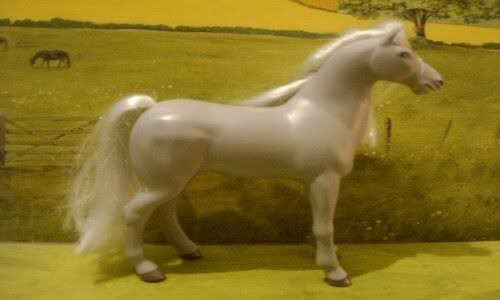
Julip is a model horse company, which has been going since 1945. (That is a year before the Pullein-Thompsons first published It Began with Pictoee). The first Julips were made out of leather, however in the 1950s, they changed their method to making horses out of latex. (Yes, Julips are always referred to as horses). In 1989, Julip started a new series called "Horse of The Year", which was made out of plastic, and these are the sorts of horses featured on the cover. In the 1990s, Julip must have asked Christine to write a book featuring the then current range, hence why Sundance Saves The Day exists. For those of you unfamiliar with the names of the horses: Sundance is the palomino on the cover, Jigsaw is the skewbald (brown and white) and Midnight is the black on the cover. There is a another horse which is not pictured which is featured, called Silver Cloud, which is a a grey horse (pictured below).

Julip have never sold their horses in major stores; though they had a store in London until 1996. They also must have sold horses in Hamleys and Harrods at one point: there are horses which come with special rugs emblazoning the company about. Until a couple of years ago, the only way to get Julip horses (and other stuff they used to sell, such as grooming kits for real horses, jodhpurs and even riding hats) was to order through a catalogue. So really, this accounts for it being quite a rareish book, because unless you happen to have a Julip catalogue, you wouldnt know about this. Here is an example of the advert.

Anyway, back to the book. The blurb reads:-

'Suddenly the others were all around Mandy and Midnight, throwing themselves off their mounts and saying things like "Oh no! How could it happen?" And, "Why didn't you see the hole?" And, "Is he going to be all right?" And, "What about you Mandy?" And Midnight was standing with his head down, a pathetic object who held up his poor, right foreleg as though it were broken.
"I think we need a vet," suggested Jack in a sombre voice.
"We're not having him shot, even if it is broken," cried Nicky, "Because breaks can be mended. We all know that."
Now they were all suddenly deadly calm, while their horses blew through their noses and warm steam rose from their backs.....'


Sundance, Jigsaw, Midnight and Silver Cloud arrive with their riders Sarah, Jack, Mandy and Nicky to take part on a 20 mile sponsored ride. They have all worked hard finding sponsors and they are raising money for needy children in faraway lands. Spirits are high. But after a few miles their adventures begin. Enthusiasm and excitement turn to panic and disappointment and a long gruelling day lies ahead.


The characters in this book are based on the Julip model ponies and their riders.

Firstly, whoever wrote this blurb is obviously not knowledgeable: Julips regardless of their size are never referred to as ponies.

The subject of sponsored pony rides has never been a popular one: I can only think of one other example which is Bobbie's Sponsored Ride by Justine Furminger. This book is aimed at a much younger audience than many of CPT's book, though it is meant for older readers than the Candy or Sophy series. I would suggest an 9-12 year old.

Though it is hardly one of CPT's best, all the blame must not be put on CPT however. The names are a bit clunky in places. However as CPT did not choose the names, but instead she based it on the (then) current Julip range. It is worth pointing out that all the characters (horses and people) with the exception of Mrs Spencer, Mrs Walker and Desmond were available to buy from Julip. 

Like the Candy series, or rather specifically Candy Stops A Train, there are no anti heroes, no real enemies. However unlike the Candy series there is drama, though it is not a great deal of depth. However Sundance Saves The Day is hardly one of CPT's lengthier reads: it only totals 92 pages.


For me it didnt set the world on fire, it is a pleasant enough read, but the lack of depth meant that there was no real warmness to the characters. This story didnt make me warm to them, I didnt really care. Midnight has an accident during the story (the single most important bit of drama to the story, which is given away by the blurb), I didnt show great empathy for the characters. Because it is a younger children's story I just knew that everything would be alright. Because CPT doesnt do death (DPT did) and because of the age range I knew Midnight would survive. Death is always harrowing in pony books, and because of this, it is never tackled in this age range. Quite rightly it should be harrowing, but I feel that (aside from the fact that CPT doesnt do 
death) CPT felt it was too much for the age range the book was aimed at to take it all in. Pony books at this age range are still supposed to encourage you with adventure, not the nitty gritty of life.  But that is all very well the single pivotal episode of this story was tinged with "we know that everything is going to be alright and Midnight will be not shot". 


Everything does flow along nicely though, and with the exception of the naming issue, is hardly jerky. In short, it is a inoffensive story, which is in the middle. Not one of CPT's worst books, but certainly not the best. Hats off it must be said to CPT, who has tackled, in what must be said a valiant effort a subject which is hardly written about much; that is the sponsored ride. It is also must be commended for having the spirit to tackle characters and ponies which she hasnt had to make up herself, in essence they were given on a plate, because she had to deal with characters and concepts which werent her own. I am not entirely sure whether or not that made CPT's life easier or harder. But commendation has to be said for Julip's owner for at the time, for getting a worthwhile and highly talented writer,  rather than a writer who I feel would not be up to the job because they wouldnt have had the sheer scope and history that CPT has (the only other author I feel would be up to the job - with the exception of DPT and JPT - is K M Peyton). For that has to be a high recommendation, rather than the owner going for a more modern and less than capable author. Pony books were going strong, and the amount of pony book author still around at the time was more numerous than today.


It is illustrated by Mark Smallman. The illustrations are possibly the worst out of all the CPT books, they are rough outlines. Consquently there are not much style and substance to them at all. They are simply lines, in some ways glorified stickmen. They are IMO, slapdash and a little amateurish.Not the best illustration to grace a pony book.

Friday, 9 September 2011

Review: ALL THREE - Fair Girls and Grey Horses

Fair Girls and Grey Horses: Memories of a country childhood is really their second collective work, as the first was It Began with Picotee. However, unlike It Began With Picotee, this is an non fictional work. It is actually an autobiography, with all 3 sisters contributing to every chapter. This is actually a different style to It Began With Picotee, which works much better I think. However, it does lead to some duplication.

It was first published in 1996, 50 years after the publication of It Began with Picotee. The scan is of an paperback edition, which has the same cover as the hardback edition. There is also a large type edition and an audio book version (sadly, not read out by the sisters).

This book is not aimed at children, more like adult collectors or people have who have read their books as a child and are now grown up. It is not illustrated.

The blurb reads:-

'Are your twins normal?' Mrs Pullein-Thompson was asked. 'Good God, I hope not,' she retorted.

The twins were Diana and Christine who, with their elder sister Josephine, have written 150 books, which have sold in millions around the world. Now, over 50 years after the publication of their first book, It Began with Picotee, the sisters have jointly written about their extraordinary childhood with lovable but often unreliable animals and unforgettable humans.

It also mentions quite frequently their brother Denis Cannan, and their father, Cappy, of which little is known about, at least in comparison to the sisters (and their mother). It begins with some family history.

Although not meant to be funny, there are some. One particular incident is when Josephine writes "He also had an embarrassing habit of knocking the hats off men who failed to remove them for the National Anthem" when talking about how Cappy was fiercely patriotic. Also they (the sisters) had euphemisms brought by their Victorian Nana, and the confusions/chaos it sometimes caused led to some amusing incidents.

There are a few adult references, but not as much as the non pony work, A Place With Two Faces (Josephine), but the general tone would make it boring for children. There are some incidents about animals (not necessarily about horses) which provide some amusement. Some events which happened in their life did actually appear in their (or their mother's) books, though the names had been changed.

Three are also some sample of poems which have yet to appear in any other book, which gives a fascinating insight into their fruitful literary career, especially as most of them were written before the publication of It Began With Picotee. There are also some photos of their childhood.

In some ways, it shows (despite their lack of formal education) the forward-thinking of their Mamma (Joanna Cannan). Although she did send them to school at some point, she insisted that they only attended half a day, because she "believed children should enjoy their childhood", a fact that is sadly lacking these days.

All in all, a humorous book, and completely utterly enjoyable. However for me, the greatest disappointment was the fact that there was not a complete bibliography of their works included. Admittedly, Christine did write several books after this was first published. You notice to the right there is the link to the Wikipedia article which has all the books listed, but that was done by me, following many hours of research. If that was included, it would have made my life much easier. Completely and utterly fascinating, though sadly there is not much about the riding school that they owned.

Saturday, 15 December 2007

Review: DIANA - The Long Ride Home

The Long Ride Home is this week's book, and also the final Diana book we will be seeing for quite a considerable amount of time. I am aware that I have left out Black Princess, Black Romany and Black Piper, but I do plan to do all the "Black" books at the same time, by all 3 authors. It was first published in 1996, making it Diana's last book (both pony and non pony). It is not illustrated.

The blurb reads:-

"Call granny if something really awful happens and you need help" says
Carey's mother. before leaving. "You can share Sandpiper with me," Carey tells Hannah. But Hannah hates riding and soon the cottage fills with her mysterious friends. Before long the medical problem, which has dogged Cary ever since an attack of meningitis, is being exploited by Hannah and her boyfriend Steve. Then her mobile phone, Carey's lifeline, disappears. Frightened, she leaves the Scottish island with Sandpiper and her collie, Tina, and sets out to ride to her Grandmother's cottage in Yorkshire.

This is the story of Carey's long and often terrifying ride with her two beloved and sometimes awkward animals, a story of treachery and pursuit with an surprising twist at the end.


To a certain extent, this is based on Diana's own long ride (for those of you who are unaware, she rode from Land's End to John O'Groats), however she does make an comment that this book is entirely fictitious, save for the warm hospitality that she received from the Scots. Whether that bit is true or not, I have never been to Scotland or have any Scottish relatives.

In some ways this is a more modern book than Diana's previous creations, the advent of the mobile phone is an obvious example, and the mentioning of the illness is another. Pony books dont generally mention the rider's illnesses, the nearest they get is an attack of the "needle" (whatever that may be; I suspect it is another way of saying nerves). Again Neighbours is a mention of another thing (the TV programme, not the people who live nearby), TV is rarely mentioned in pony books. Presumably, people in pony books are too busy having adventures to bother about things such as TV, or in the case of the early books, very few people had TV, because they were so darned expensive. I have heard countless tales of people in the 1950s having only one television in the street, and I suppose having 101 neighbours around (the real people this time) to watch your tv was guess tough luck if you wanted peace and quiet. Or if you didn't like your neighbours, I guess you had to be uber nice to them if you wanted to watch their TV.

Anyway, back to the book. The main part is given away in the blurb, and there is a lovely detail in the way she ends up. Her parents are away, so feeling downtrodden, she goes to her granny's on horseback. The people she meets on the way, and the threat is so real that she faces. It's like you are almost there. With some pony books you feel that it is unreal, that it could never happen, but this one, it definitely not like that.

The twist is suprising at the end and totally unexpected. I really like this book, and is of the same high quality standard that we expect of Diana. It should appeal to the masses, but it is not lost either. It's surprising that many people dont talk about this book, I feel it deserves better recognition than what it does.

Next week: a Josephine book.